2026 New 200-101 Exam Dumps with PDF and VCE Free: https://www.surepassexam.com/200-101-exam-dumps.html
It is more faster and easier to pass the Cisco 200-101 exam by using Approved Cisco Interconnecting Cisco Networking Devices Part 2 (ICND2) questuins and answers. Immediate access to the Down to date 200-101 Exam and find the same core area 200-101 questions with professionally verified answers, then PASS your exam with a high score now.
NEW QUESTION 1
CORRECT TEXT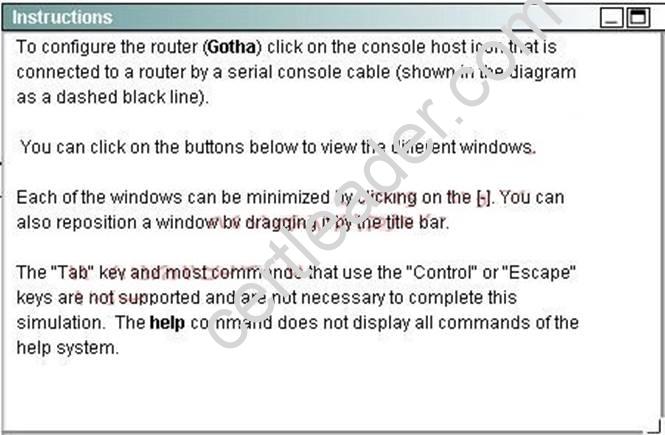

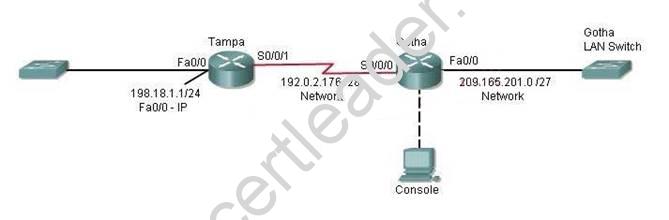
Attention:
In practical examinations, please note the following, the actual information will prevail.
1. Name of the router is xxx
2. Enable secret password is xxx
3. Password In access user EXEC mode using the console is xxx
4. The password to allow telnet access to the router is xxx
5. IP information
- A.
Answer: Router>enable
Explanation:
Router#config terminal
Router(config)#hostname Gotha
Gotha(config)#enable secret mi222ke
Gotha(config)#line console 0
Gotha(config-line)#password G8tors1
Gotha(config-line)#exit
Gotha(config)#line vty 0 4
Gotha(config-line)#password dun63lap
Gotha(config-line)#login
Gotha(config-line)#exit
Gotha(config)#interface fa0/0
Gotha(config-if)#no shutdown
Gotha(config-if)#ip address 209.165.201.4 255.255.255.224
Gotha(config)#interface s0/0/0
Gotha(config-if)#ip address 192.0.2.190 255.255.255.240
Gotha(config-if)#no shutdown
Gotha(config-if)#exit
Gotha(config)#router rip
Gotha(config-router)#version 2
Gotha(config-router)#network 209.165.201.0
Gotha(config-router)#network 192.0.2.176
Gotha(config-router)#end
Gotha#copy running-config startup-config
NEW QUESTION 2
A router is running three routing processes: RIP, OSPF, and EIGRP, each configured with default characteristics. Each process learns a route to the same remote network.
If there are no static routes to the destination and none of the routes were redistributed, which route will be placed in the IP routing table?
- A. the route learned through EIGRP
- B. the route learned through OSPF
- C. the route learned through RIP
- D. the route with the lowest metric
- E. all three routes with the router load balancing
Answer: A
Explanation:
Reference: http://www.cisco.com/en/US/tech/tk365/technologies_tech_note09186a0080094195.shtml
Administrative distance is the feature that routers use in order to select the best path. Administrative distance defines the reliability of a routing protocol. Each routing protocol is prioritized in order of most to least reliable (believable) with the help of an administrative distance value. Lowest Administrative distance will be chosen first.
NEW QUESTION 3
Scenario
Refer to the topology. Your company has connected the routers R1. R2. and R3 with serial links. R2 and R3 are connected to the switches SW1 and SW2, respectively. SW1 and SW2 are also connected to the routers R4 and R5.
The EIGRP routing protocol is configured.
You are required to troubleshoot and resolve the EIGRP issues between the various routers.
Use the appropriate show commands to troubleshoot the issues.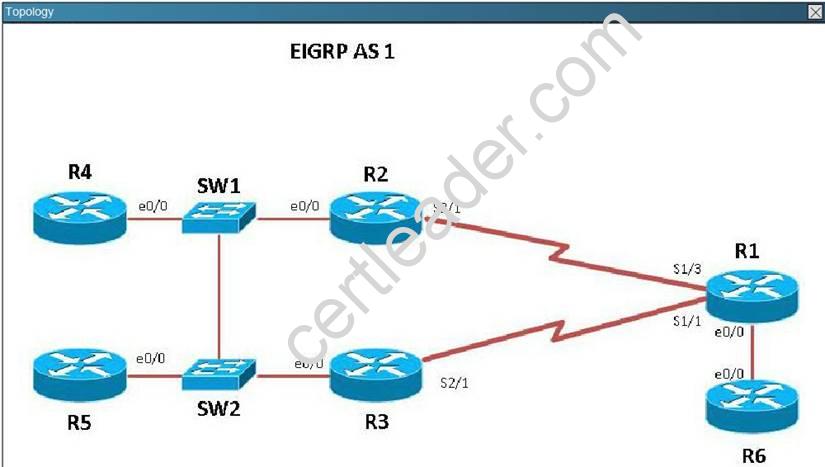
Study the following output taken on R1:
R1# Ping 10.5.5.55 source 10.1.1.1
Type escape sequence to abort.
Sending 5.100-byte ICMP Echos to 10.5.5.55, timeout is 2 seconds:
Packet sent with a source address of 10.1.1.1
Why are the pings failing?
- A. The network statement is missing on R5.
- B. The loopback interface is shut down on R5.
- C. The network statement is missing on R1.
- D. The IP address that is configured on the Lo1 interface on R5 is incorrect.
Answer: C
Explanation:
R5 does not have a route to the 10.1.1.1 network, which is the loopback0 IP address of R1. When looking at the EIGRP configuration on R1, we see that the 10.1.1.1 network statement is missing on R1.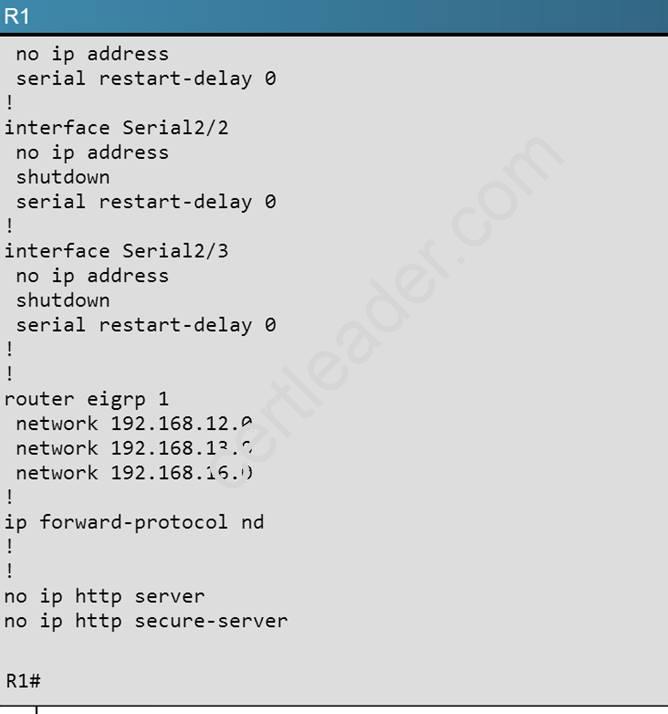
NEW QUESTION 4
Which two statements about the OSPF Router ID are true? (Choose two.)
- A. It identifies the source of a Type 1 LSA.
- B. It should be the same on all routers in an OSPF routing instance.
- C. By default, the lowest IP address on the router becomes the OSPF Router ID.
- D. The router automatically chooses the IP address of a loopback as the OSPF Router ID.
- E. It is created using the MAC Address of the loopback interface.
Answer: AD
NEW QUESTION 5
Refer to the exhibit.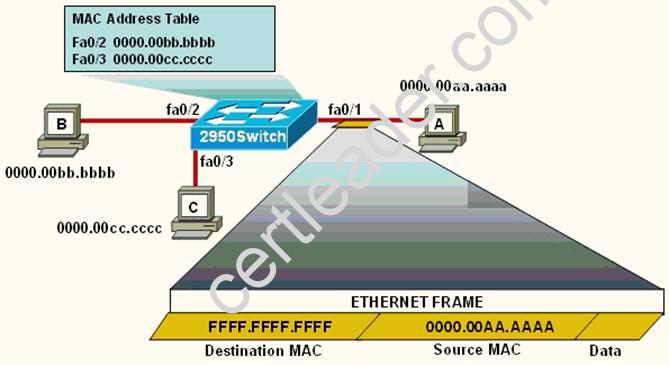
The following commands are executed on interface fa0/1 of 2950Switch.
2950Switch(config-if)# switchport port-security
2950Switch(config-if)# switchport port-security mac-address sticky
2950Switch(config-if)# switchport port-security maximum 1
The Ethernet frame that is shown arrives on interface fa0/1. What two functions will occur when this frame is received by 2950Switch? (Choose two.)
- A. The MAC address table will now have an additional entry of fa0/1 FFFF.FFFF.FFFF.
- B. Only host A will be allowed to transmit frames on fa0/1.
- C. This frame will be discarded when it is received by 2950Switch.
- D. All frames arriving on 2950Switch with a destination of 0000.00aa.aaaa will be forwarded out fa0/1.
- E. Hosts B and C may forward frames out fa0/1 but frames arriving from other switches will not be forwarded out fa0/1.
- F. Only frames from source 0000.00bb.bbbb, the first learned MAC address of 2950Switch, will be forwarded out fa0/1.
Answer: BD
NEW QUESTION 6
A network administrator is troubleshooting an EIGRP problem on a router and needs to confirm the IP addresses of the devices with which the router has established adjacency.
The retransmit interval and the queue counts for the adjacent routers also need to be checked. What command will display the required information?
- A. Router# show ip eigrp adjacency
- B. Router# show ip eigrp topology
- C. Router#show ip eigrp interfaces
- D. Router#show ip eigrp neighbors
Answer: D
Explanation:
Implementing EIGRP
http://www.ciscopress.com/articles/article.asp?p=1171169&seqNum=3
Below is an example of the show ip eigrp neighbors command. The retransmit interval (Smooth Round Trip Timer – SRTT) and the queue counts (Q count, which shows the number of queued EIGRP packets) for the adjacent routers are listed:
R1#show ip eigrp neighbors
IP-EIGRP neighbors for process 1
H Address Interface Hold Uptime SRTT RTO Q Seq (sec) (ms) Cnt Num 0 10.10.10.2 Fa0/0 12 00:00:39 1282 5000 0 3
NEW QUESTION 7
Refer to the exhibit.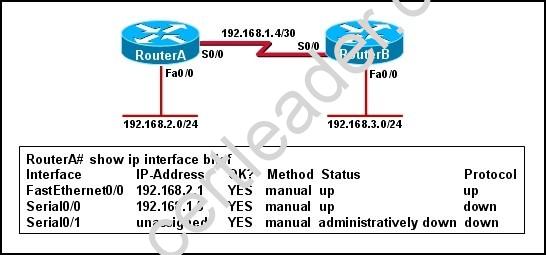
Hosts in network 192.168.2.0 are unable to reach hosts in network 192.168.3.0. Based on the output from RouterA, what are two possible reasons for the failure? (Choose two.)
- A. The cable that is connected to S0/0 on RouterA is faulty.
- B. Interface S0/0 on RouterB is administratively down.
- C. Interface S0/0 on RouterA is configured with an incorrect subnet mask.
- D. The IP address that is configured on S0/0 of RouterB is not in the correct subnet.
- E. Interface S0/0 on RouterA is not receiving a clock signal from the CSU/DSU.
- F. The encapsulation that is configured on S0/0 of RouterB does not match the encapsulation that is configured on S0/0 of RouterA.
Answer: EF
Explanation:
http://www.cisco.com/en/US/docs/routers/access/800/819/software/configuration/Guide/6se r_conf.html
NEW QUESTION 8
Refer to the exhibit.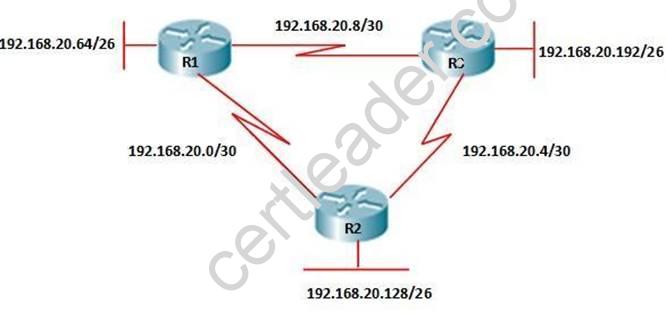
The company uses EIGRP as the routing protocol. What path will packets take from a host on
192.168.10.192/26 network to a host on the LAN attached to router R1?
R3# show ip route
Gateway of last resort is not set
192 168.20.0/24 is variably subnetted, 6 subnets, 2 masks
D 192.168.20.64/26 [90/2195456] via 192.168.20.9, 00:03:31, Serial0/0
D 192.168.20.0/30 [90/2681856] via 192.168.20.9, 00:03:31, Serial0/0
C 192.168.20.4/30 is directly connected, Serial0/1
C 192.168.20.8/30 is directly connected, Serial0/0
C 192.168.20.192/26 is directly connected, FastEthernet0/0
D 192.168.20.128/26 [90/2195456] via 192.168.20.5,00:03:31, Serial0/1
- A. The path of the packets will be R3 to R2 to R1
- B. The path of the packets will be R3 to R1 to R2
- C. The path of the packets will be both R3 to R2 to R1 and R3 to R1
- D. The path of the packets will be R3 to R1
Answer: D
Explanation:
EIGRP Questions http://www.9tut.net/icnd2/eigrp-questions
http://www.orbitco-ccna-pastquestions.com/CCNA---EIGRP-Common-Question.php
Looking at the output display above, the LAN attached to router R1 belongs to 192.168.20.64/26 subnet and learned this network via 192.168.20.9 which will be an IP address in 192.168.20.8/30 sub-network. This means that packets destined for 192.168.20.64 will be routed from R3 to R1.
NEW QUESTION 9
Which protocol is an open standard protocol framework that is commonly used in VPNs, to provide secure end-to-end communications?
- A. RSA
- B. L2TP
- C. IPsec
- D. PPTP
Answer: C
Explanation:
Internet Protocol Security (IPsec) is a technology protocol suite for securing Internet Protocol (IP) communications by authenticating and/or encrypting each IP packet of a communication session. IPsec also includes protocols for establishing mutual authentication between agents at the beginning of the session and negotiation of cryptographic keys to be used during the session.
NEW QUESTION 10
Which two statements describe the process identifier that is used in the command to configure OSPF on a router? (Choose two.)
Router(config)# router ospf 1
- A. All OSPF routers in an area must have the same process ID.
- B. Only one process number can be used on the same router.
- C. Different process identifiers can be used to run multiple OSPF processes
- D. The process number can be any number from 1 to 65,535.
- E. Hello packets are sent to each neighbor to determine the processor identifier.
Answer: CD
Explanation:
we all know that The areas can be any number from 0 to 4.2 billion and 1 to 65,535 for the Process ID.
The process ID is the ID of the OSPF process to which the interface belongs. The process ID is local to the router, and two OSPF neighboring routers can have different OSPF process IDs. (This is not true of Enhanced Interior Gateway Routing Protocol [EIGRP], in which the routers need to be in the same autonomous system). Cisco IOS Software can run multiple OSPF processes on the same router, and the process ID merely distinguishes one process from the another. The process ID should be a positive integer.
NEW QUESTION 11
Refer to the exhibit.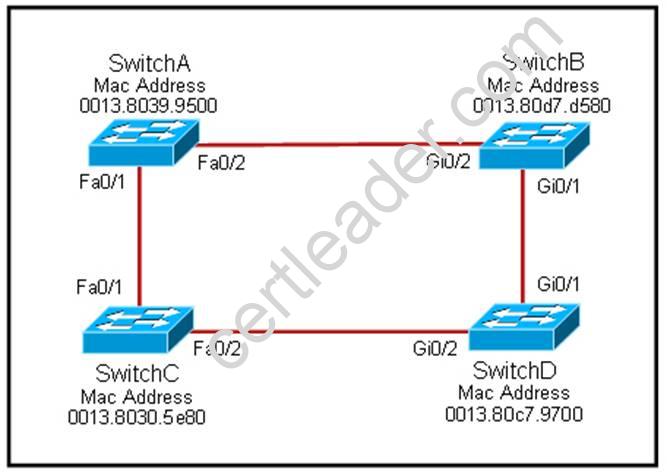
Each of these four switches has been configured with a hostname, as well as being configured to run RSTP. No other configuration changes have been made. Which three of these show the correct RSTP port roles for the indicated switches and interfaces? (Choose three.)
- A. SwitchA, Fa0/2, designated
- B. SwitchA, Fa0/1, root
- C. SwitchB, Gi0/2, root
- D. SwitchB, Gi0/1, designated
- E. SwitchC, Fa0/2, root
- F. SwitchD, Gi0/2, root
Answer: ABF
Explanation:
The question says "no other configuration changes have been made" so we can understand these switches have the same bridge priority. SwitchC has lowest MAC address so, it will become root bridge and 2 of its ports (Fa0/1 & Fa0/2) will be designated ports (DP). Because SwitchC is the root bridge the 2 ports nearest SwitchC on SwitchA (Fa0/1) and SwitchD (Gi0/2) will be root ports (RP) -> B and F are correct.
SwitchB must have a root port so which port will it choose? To answer this question we need to know about STP cost and port cost.
In general, "cost" is calculated based on bandwidth of the link. The higher the bandwidth on a link, the lower the value of its cost. Below are the cost values you should memorize:
Link speed Cost SwitchB will choose the interface with lower cost to the root bridge as the root port so we must calculate the cost on interface Gi0/1 & Gi0/2 of SwitchB to the root bridge. This can be calculated from the "cost to the root bridge" of each switch because a switch always advertises its cost to the root bridge in its BPDU. The receiving switch will add its local port cost value to the cost in the BPDU.
SwitchC advertises its cost to the root bridge with a value of 0. Switch D adds 4 (the cost value of 1Gbps link) and advertises this value (4) to SwitchB. SwitchB adds another 4 and learns that it can reach SwitchC via Gi0/1 port with a total cost of 8. The same process happens for SwitchA and SwitchB learns that it can reach SwitchC via Gi0/2 with a total cost of 23 -> Switch B chooses Gi0/1 as its root port.
Now our last task is to identify the port roles of the ports between SwitchA & SwitchB. It is rather easy as the MAC address of SwitchA is lower than that of SwitchB so Fa0/2 of SwitchA will be designated port while Gi0/2 of SwitchB will be alternative port.
NEW QUESTION 12
The command frame-relay map ip 10.121.16.8 102 broadcast was entered on the router. Which of the following statements is true concerning this command?
- A. This command should be executed from the global configuration mode.
- B. The IP address 10.121.16.8 is the local router port used to forward data.
- C. 102 is the remote DLCI that will receive the information.
- D. This command is required for all Frame Relay configurations.
- E. The broadcast option allows packets, such as RIP updates, to be forwarded across the PVC.
Answer: E
Explanation:
The command frame-relay map ip 10.121.16.8 102 broadcast means to map the remote IP 10.121.16.8 to the local DLCI 102. When the “broadcast” keyword is included, it turns Frame Relay network as a broadcast network, which can forward broadcasts.
NEW QUESTION 13
Refer to the exhibit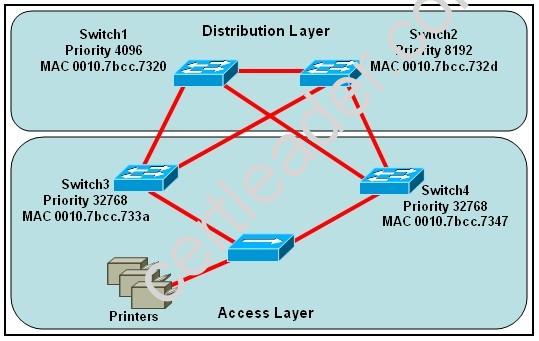
Which switch provides the spanning-tree designated port role for the network segment that services the printers?
- A. Switch1
- B. Switch2
- C. Switch3
- D. Switch4
Answer: C
Explanation:
First, the question asks what switch services the printers, so it can be Switch 3 or Switch 4 which is connected directly to the Printers.
Designated port is a port that is in the forwarding state. All ports of the root bridge are designated ports.
Switch 3 and Switch 4 has same priority so it will see on lowest MAC address and here switch 3 has lowest MAC address. So switch 3 segment will play a Designated port role. By comparing the MAC address of Switch 3 and Switch 4 we found that the MAC of Switch 3 is smaller. Therefore the interface connected to the Printers of Switch 3 will become designated interface and the interface of Switch 4 will be blocked.
NEW QUESTION 14
Which statement describes the process ID that is used to run OSPF on a router?
- A. It is globally significant and is used to represent the AS number.
- B. It is locally significant and is used to identify an instance of the OSPF database.
- C. It is globally significant and is used to identify OSPF stub areas.
- D. It is locally significant and must be the same throughout an area.
Answer: B
NEW QUESTION 15
Refer to the exhibit.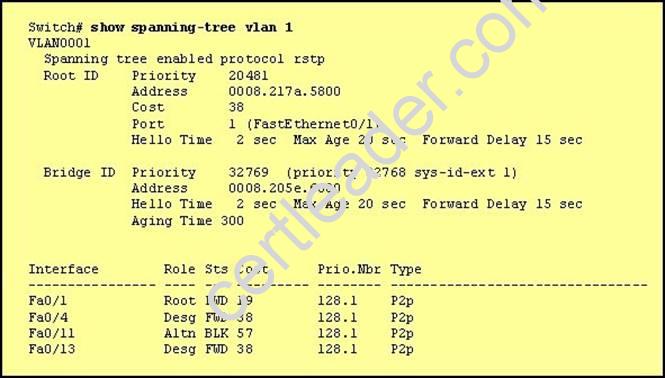
Why has this switch not been elected the root bridge for VLAN1?
- A. It has more than one interface that is connected to the root network segment.
- B. It is running RSTP while the elected root bridge is running 802.1d spanning tree.
- C. It has a higher MAC address than the elected root bridge.
- D. It has a higher bridge ID than the elected root bridge.
Answer: D
Explanation:
http://www.cisco.com/en/US/tech/tk389/tk621/technologies_tech_note09186a008009482f.s html
When a switch receives a BPDU, it first compares priority, the lower number wins. If a tie, compare MAC, the smaller one wins. Here Switch has 32769 priority which is greater than 20481 so switch will not elect for root bridge. It says the bridge priority for Switch is 32769, andthe root priority is 20481. Which means that some other switch has the lower priority and won the election for VLAN 1.
NEW QUESTION 16
Which command allows you to verify the encapsulation type (CISCO or IETF) for a Frame Relay link?
- A. show frame-relay lmi
- B. show frame-relay map
- C. show frame-relay pvc
- D. show interfaces serial
Answer: B
Explanation:
map will show frame relay encapsulation (cisco or ietf) http://www.cisco.com/en/US/docs/ios/12_2/wan/command/reference/wrffr4.html#wp102934 3
"show frame-relay map" will show frame relay encapsulation type (CISCO or IETF)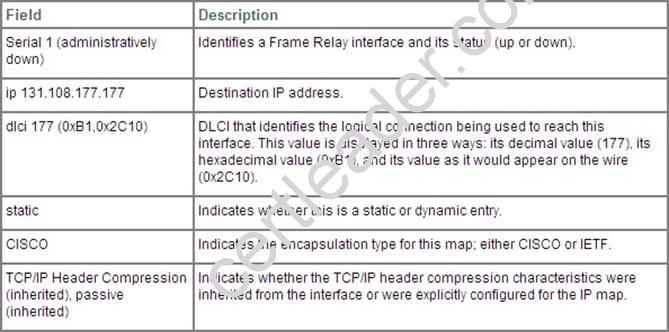
NEW QUESTION 17
What is the default administrative distance of OSPF?
- A. 90
- B. 100
- C. 110
- D. 120
Answer: C
Explanation:
Default Distance Value Table
This table lists the administrative distance default values of the protocols that Cisco supports: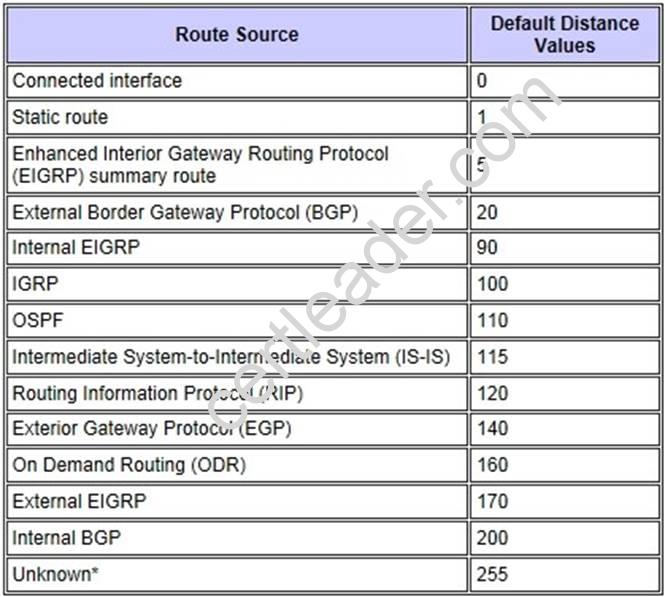
NEW QUESTION 18
Which statement describes VRRP object tracking?
- A. It monitors traffic flow and link utilization.
- B. It ensures the best VRRP router is the virtual router master for the group.
- C. It causes traffic to dynamically move to higher bandwidth links.
- D. It thwarts man-in-the-middle attacks.
Answer: B
NEW QUESTION 19
Refer to the exhibit.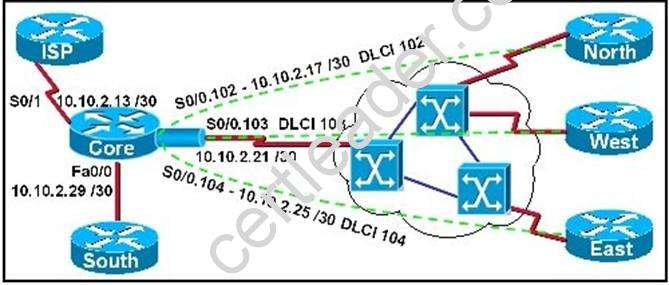
The network associate is configuring OSPF on the Core router. All the connections to the branches should be participating in OSPF. The link to the ISP should NOT participate in OSPF and should only be advertised as the default route. What set of commands will properly configure the Core router?
- A. Core(config-router)# default-information originate Core(config-router)# network 10.0.0.0 0.255.255.255 area 0 Core(config-router)# exitCore(config)# ip route 0.0.0.0 0.0.0.0 10.10.2.14
- B. Core(config-router)# default-information originate Core(config-router)# network 10.10.2.13 0.0.0.242 area 0 Core(config-router)# exitCore(config)# ip route 0.0.0.0 0.0.0.0 10.10.2.14
- C. Core(config-router)# default-information originate Core(config-router)# network 10.10.2.16 0.0.0.15 area 0 Core(config-router)# exitCore(config)# ip route 0.0.0.0 0.0.0.0 10.10.2.14
- D. Core(config-router)# default-information originate Core(config-router)# network 10.10.2.32 0.0.0.31 area 0 Core(config-router)# exitCore(config)# ip route 0.0.0.0 0.0.0.0 10.10.2.14
Answer: C
Explanation:
There are two ways to inject a default route into a normal area.1. If the ASBR already has the default route in its routing table, you can advertise theexisting 0.0.0.0/0 into the OSPF domain with the default-information originate router configuration command.2. If the ASBR doesn’t have a default route, you can add the keyword always to the default- information originate command (default-information originate always).This command will advertise a default route into the OSPF domain, regardless of whether it has a route to
0.0.0.0. Another benefit of adding always keyword is that it can add stability to the internetwork. For example, if the ASBR is learning a default route from another routing domain such as RIP and this route is flapping, then without the always keyword, each time the route flaps, the ASBR will send a new Type 5 LSA into the OSPF domain causing some instability inside the OSPF domain. With the always keyword, the ASBR will advertise the default inside the OSPF domain always,In the example shown here, only choice C is correct as the wildcard mask correctly specifies the 10.10.2.16 0.0.0.15 networks, which include all IP addresses in the 10.10.2.16-10.10.2.31 range. In this question we were told that the ISP link should NOT be configured for OSPF, making choice A incorrect. http://www.cisco.com/en/US/tech/tk365/technologies_configuration_example09186a00801 ec9f0.shtml
NEW QUESTION 20
CORRECT TEXT
A new switch is being added to the River Campus LAN. You will work to complete this process by first configuring the building_2 switch with an IP address and default gateway. For the switch host address, you should use the last available IP address on the management subnet. In addition, the switch needs to be configured to be in the same VTP domain as the building_1 switch and also needs to be configured as a VTP client. Assume that the IP configuration and VTP configuration on building_1 are complete and correct. The configuration of the router is not accessible for this exercise. You must accomplish the following tasks:
Determine and configure the IP host address of the new switch. Determine and configure the default gateway of the new switch. Determine and configure the correct VTP domain name for the new switch.
Configure the new switch as a VTP client.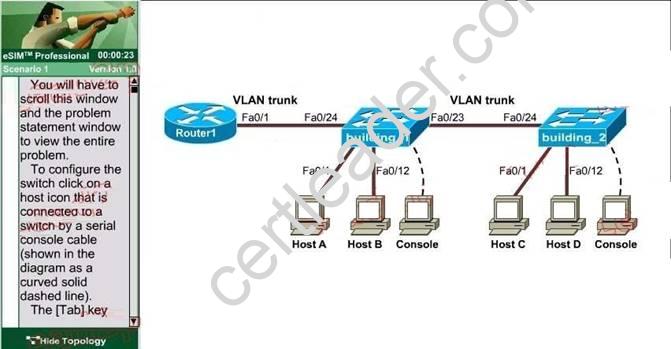
- A.
Answer: HerearetheStepsforthisLabSolution:
Explanation:
The question states we can't access the router so we can only get required information from switch building_1. Click on the PC connected with switch building_1 (through a console line) to access switch building_1s CLI. On this switch use the show running-config command:
building_1#show running-config
Next use the show vtp status command to learn about the vtp domain on this switch building_1#show vtp status
(Notice: the IP address, IP default-gateway and VTP domain name might be different!!!) You should write down these 3 parameters carefully.
Configuring the new switch
+ Determine and configure the IP host address of the new switch The question requires "for the switch host address, you should use the last available IP address on the management subnet". The building_1 switch's IP address, which is 192.168.22.50 255.255.255.224, belongs to the management subnet.
Increment: 32 (because 224 = 1110 0000)
Network address: 192.168.22.32
Broadcast address: 192.168.22.63
->The last available IP address on the management subnet is 192.168.22.62 and it hasn't been used (notice that the IP address of Fa0/1 interface of the router is also the default gateway address 192.168.22.35).
Also notice that the management IP address of a switch should be configured in Vlan1 interface. After it is configured, we can connect to it via telnet or SSH to manage it. Switch2#configure terminal
Switch2(config)#interface Vlan1
Switch2(config-if)#ip address 192.168.22.62 255.255.255.224
Switch2(config-if)#no shutdown (not really necessary since VLAN interfaces are not physical and are not shut
down but, no harm in doing so and is good practice for physical ports)
+ Determine and configure the default gateway of the new switch The default gateway of this new switch is same as that of building_1 switch, which is 192.168.22.35 Switch2(config-if)#exit
Switch2(config)#ip default-gateway 192.168.22.35
+ Determine and configure the correct VTP domain name for the new switch The VTP domain name shown on building_1 switch is Cisco so we have to use it in the new switch (notice: the VTP domain name will be different in the exam and it is case sensitive so be careful)
Switch2(config)#vtp domain Cisco
+ Configure the new switch as a VTP client Switch2(config)#vtp mode client
We should check the new configuration with the "show running-config" & "show vtp status"; also try pinging from the new switch to the the default gateway to make sure it works well. Finally save the configuration:
Switch2(config)#exit
Switch2#copy running-config startup-config
NEW QUESTION 21
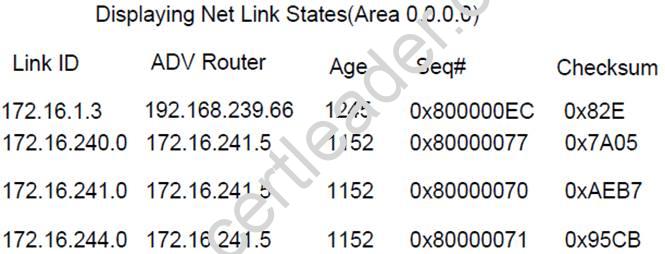
Which command is used to display the collection of OSPF link states?
- A. show ip ospf link-state
- B. show ip ospf lsa database
- C. show ip ospf neighbors
- D. show ip ospf database
Answer: D
Explanation:
http://www.cisco.com/en/US/docs/ios/iproute_ospf/command/reference/iro_osp3.html#wp1 01217
Examples
The following is sample output from the show ip ospf database command when no arguments or keywords are used:
Router# show ip ospf database
OSPF Router with id(192.168.239.66) (Process ID 300)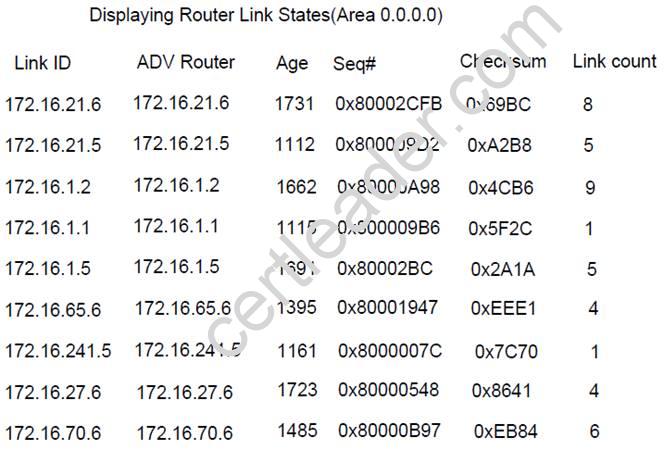
NEW QUESTION 22
......
Recommend!! Get the Full 200-101 dumps in VCE and PDF From Certshared, Welcome to Download: https://www.certshared.com/exam/200-101/ (New 149 Q&As Version)