2026 New AZ-104 Exam Dumps with PDF and VCE Free: https://www.surepassexam.com/AZ-104-exam-dumps.html
It is more faster and easier to pass the Microsoft AZ-104 exam by using Tested Microsoft Microsoft Azure Administrator (beta) questuins and answers. Immediate access to the Most up-to-date AZ-104 Exam and find the same core area AZ-104 questions with professionally verified answers, then PASS your exam with a high score now.
Free demo questions for Microsoft AZ-104 Exam Dumps Below:
NEW QUESTION 1
You have an Azure subscription that contains a storage account named account1.
You plan to upload the disk files of a virtual machine to account1 from your on-premises network. The on-premises network uses a public IP address space of 131.107.1.0/24.
You plan to use the disk files to provision an Azure virtual machine named VM1. VM1 will be attached to a virtual network named VNet1. VNet1 uses an IP address space of 192.168.0.0/24.
You need to configure account1 to meet the following requirements:  Ensure that you can upload the disk files to account1. Ensure that you can attach the disks to VM1. Prevent all other access to account1.
Which two actions should you perform? Each correct selection presents part of the solution.
NOTE: Each correct selection is worth one point.
- A. From the Firewalls and virtual networks blade of account1, add the 131.107.1.0/24 IP address range.
- B. From the Firewalls and virtual networks blade of account1, select Selected networks.
- C. From the Firewalls and virtual networks blade of acount1, add VNet1.
- D. From the Firewalls and virtual networks blade of account1, select Allow trusted Microsoft services to access this storage account.
- E. From the Service endpoints blade of VNet1, add a service endpoint.
Answer: BE
Explanation:
B: By default, storage accounts accept connections from clients on any network. To limit access to selected networks, you must first change the default action.
Azure portal Navigate to the storage account you want to secure. Click on the settings menu called Firewalls and virtual networks. To deny access by default, choose to allow access from 'Selected networks'. To allow traffic from all networks, choose to allow access from 'All networks'. Click Save to apply your changes. E: Grant access from a Virtual Network
Storage accounts can be configured to allow access only from specific Azure Virtual Networks.
By enabling a Service Endpoint for Azure Storage within the Virtual Network, traffic is ensured an optimal route to the Azure Storage service. The identities of the virtual network and the subnet are also transmitted with each request.
References: https://docs.microsoft.com/en-us/azure/storage/common/storage-network-security
NEW QUESTION 2
You have an Azure Linux virtual machine that is protected by Azure Backup. One week ago, two files were deleted from the virtual machine.
You need to restore the deleted files to an on-premises computer as quickly as possible.
Which four actions should you perform in sequence? To answer, move the appropriate actions from the list of actions to the answer area and arrange them in the correct order.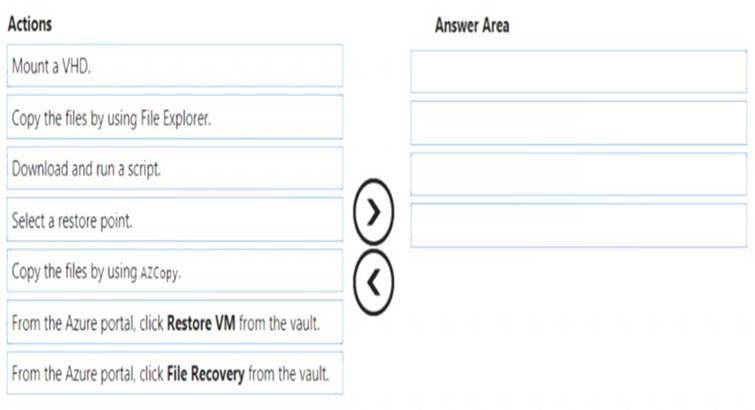
- A. Mastered
- B. Not Mastered
Answer: A
Explanation:
To restore files or folders from the recovery point, go to the virtual machine and choose the desired recovery point.
Step 0. In the virtual machine's menu, click Backup to open the Backup dashboard. Step 1. In the Backup dashboard menu, click File Recovery.
Step 2. From the Select recovery point drop-down menu, select the recovery point that holds the files you want. By default, the latest recovery point is already selected.
Step 3: To download the software used to copy files from the recovery point, click Download Executable (for Windows Azure VM) or Download Script (for Linux Azure VM, a python script is generated).
Step 4: Copy the files by using AzCopy
AzCopy is a command-line utility designed for copying data to/from Microsoft Azure Blob, File, and Table storage, using simple commands designed for optimal performance. You can copy data between a file system and a storage account, or between storage accounts.
References:
https://docs.microsoft.com/en-us/azure/backup/backup-azure-restore-files-from-vm https://docs.microsoft.com/en-us/azure/storage/common/storage-use-azcopy
NEW QUESTION 3
You have several Azure virtual machines on a virtual network named VNet1. You configure an Azure Storage account as shown in the following exhibit.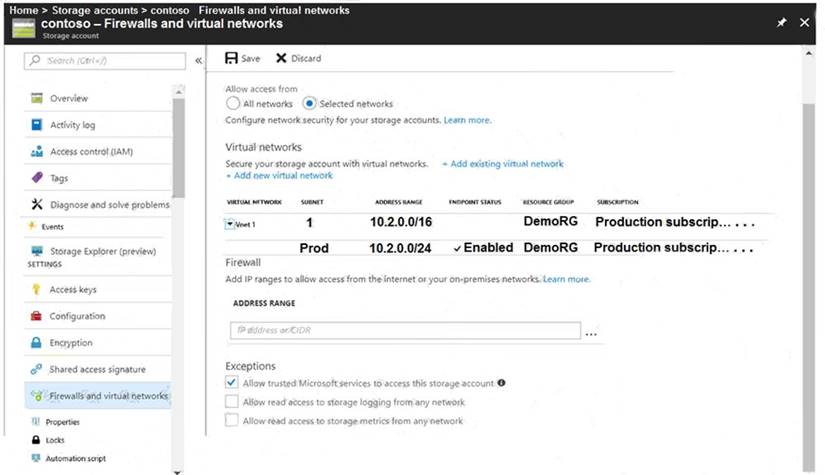
Use the drop-down menus to select the answer choice that completes each statement based on the information presented in the graphic.
NOTE: Each correct selection is worth one point.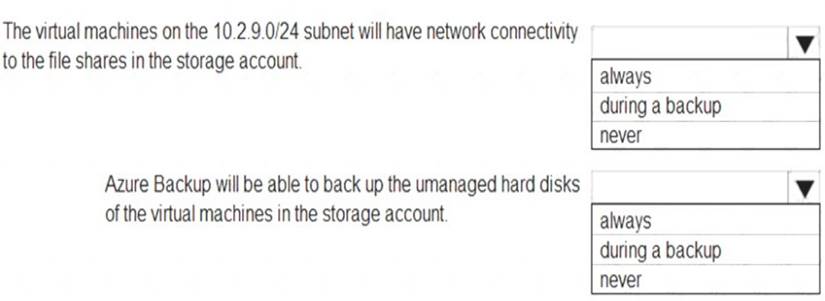
- A. Mastered
- B. Not Mastered
Answer: A
Explanation:
Box 1: always
Endpoint status is enabled. Box 2: Never
After you configure firewall and virtual network settings for your storage account, select Allow trusted Microsoft services to access this storage account as an exception to enable Azure Backup service to access the network restricted storage account.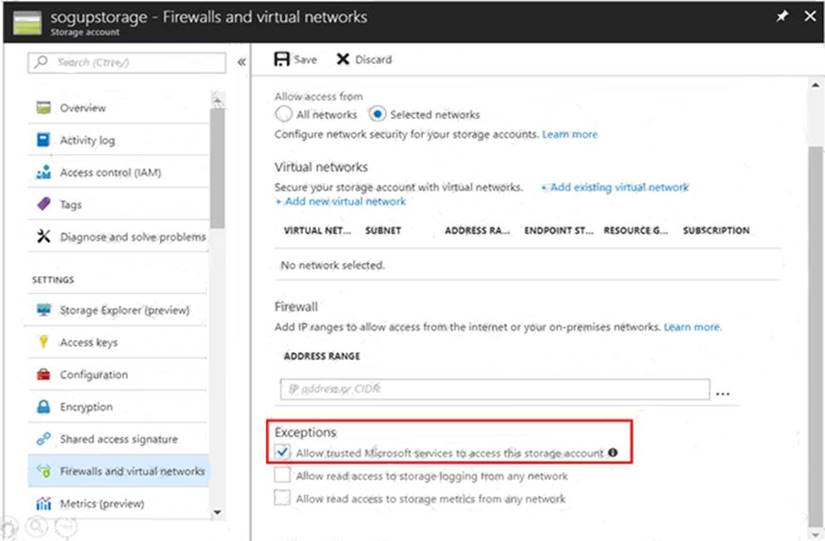
Reference:
https://docs.microsoft.com/en-us/azure/storage/files/storage-how-to-use-files-windows https://azure.microsoft.com/en-us/blog/azure-backup-now-supports-storage-accounts-secured-with-azure-storage
NEW QUESTION 4
You have an Azure subscription that contains the public load balancers shown in the following table.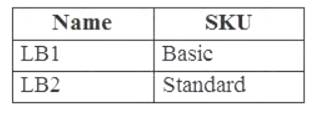
You plan to create six virtual machines and to load balancer requests to the virtual machines. Each load balancer will load balance three virtual machines.
You need to create the virtual machines for the planned solution.
How should you create the virtual machines? To answer, select the appropriate options in the answer area.
NOTE: Each correct selection is worth one point.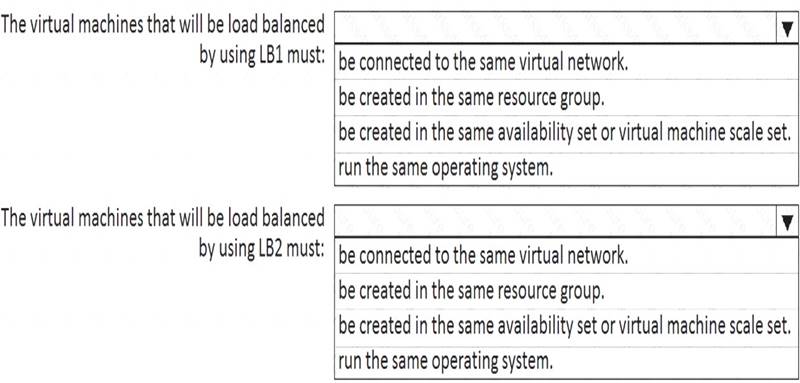
- A. Mastered
- B. Not Mastered
Answer: A
Explanation:
Box 1: be created in the same availability set or virtual machine scale set.
The Basic tier is quite restrictive. A load balancer is restricted to a single availability set, virtual machine scale set, or a single machine.
Box 2: be connected to the same virtual network
The Standard tier can span any virtual machine in a single virtual network, including blends of scale sets, availability sets, and machines.
References:
https://www.petri.com/comparing-basic-standard-azure-load-balancers
NEW QUESTION 5
You have an Azure policy as shown in the following exhibit.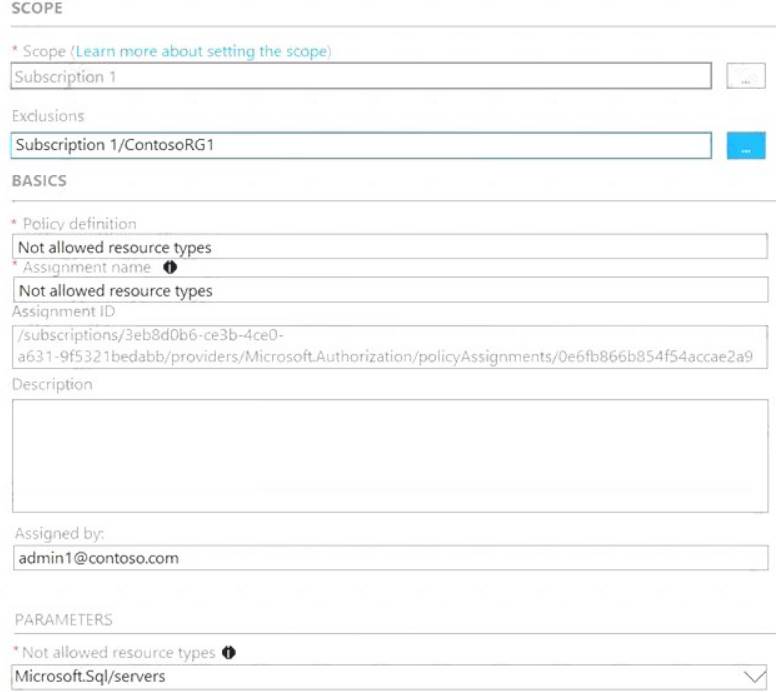
What is the effect of the policy?
Which of the following statements are true?
- A. You can create Azure SQL servers in ContosoRG1.
- B. You are prevented from creating Azure SQL servers anywhere in Subscription 1.
- C. You are prevented from creating Azure SQL Servers in ContosoRG1 only.
- D. You can create Azure SQL servers in any resource group within Subscription 1.
Answer: A
Explanation:
You are prevented from creating Azure SQL servers anywhere in Subscription 1 with the exception of ContosoRG1
NEW QUESTION 6
Note: This question is part of a series of questions that present the same scenario. Each question in the series contains a unique solution that might meet the stated goals. Some question sets might have more than one correct solution, while others might not have a correct solution.
After you answer a question in this section, you will NOT be able to return to it. As a result, these questions will not appear in the review screen.
You have an Azure Active Directory (Azure AD) tenant named Adatum and an Azure Subscription named Subscription1. Adatum contains a group named Developers. Subscription1 contains a resource group named Dev.
You need to provide the Developers group with the ability to create Azure logic apps in the Dev resource group.
Solution: On Dev, you assign the Contributor role to the Developers group. Does this meet the goal?
- A. Yes
- B. No
Answer: B
Explanation:
The Logic App Contributor role lets you manage logic app, but not access to them. It provides access to view, edit, and update a logic app.
References:
https://docs.microsoft.com/en-us/azure/role-based-access-control/built-in-roles https://docs.microsoft.com/en-us/azure/logic-apps/logic-apps-securing-a-logic-app
NEW QUESTION 7
You have an Azure virtual network named VNet1 that connects to your on-premises network by using a site-to-site VPN. VMet1 contains one subnet named Subnet1.
Subnet1 is associated to a network security group (NSG) named NSG1. Subnet1 contains a basic internal load balancer named ILB1. ILB1 has three Azure virtual machines in the backend pool.
You need to collect data about the IP addresses that connects to ILB1. You must be able to run interactive queries from the Azure portal against the collected data.
What should you do? To answer, select the appropriate options in the answer area. NOTE: Each correct selection is worth one point.
- A. Mastered
- B. Not Mastered
Answer: A
Explanation:
Box 1: An Azure Log Analytics workspace
In the Azure portal you can set up a Log Analytics workspace, which is a unique Log Analytics environment with its own data repository, data sources, and solutions
Box 2: ILB1
References:
https://docs.microsoft.com/en-us/azure/log-analytics/log-analytics-quick-create-workspace
https://docs.microsoft.com/en-us/azure/load-balancer/load-balancer-standard-diagnostics
NEW QUESTION 8
You have an Azure subscription.
Users access the resources in the subscription from either home or from customer sites. From home, users must establish a point-to-site VPN to access the Azure resources. The users on the customer sites access the Azure resources by using site-to-site VPNs.
You have a line-of-business app named App1 that runs on several Azure virtual machine. The virtual machines run Windows Server 2021.
You need to ensure that the connections to App1 are spread across all the virtual machines.
What are two possible Azure services that you can use? Each correct answer presents a complete solution.
NOTE: Each correct selection is worth one point.
- A. a public load balancer
- B. Traffic Manager
- C. an Azure Content Delivery Network (CDN)
- D. an internal load balancer
- E. an Azure Application Gateway
Answer: DE
NEW QUESTION 9
You have an Azure subscription that contains the storage accounts shown in the following table.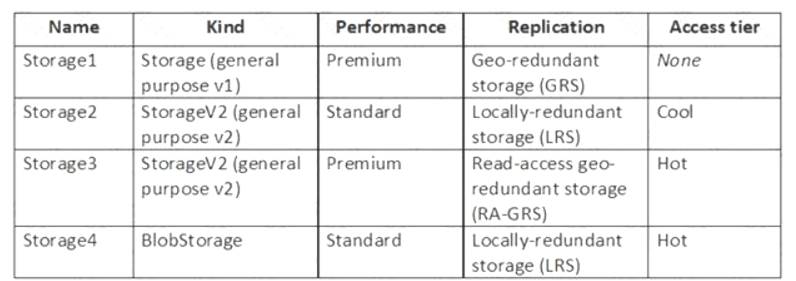
You need to identify which storage account can be converted to zone-redundant storage (ZRS) replication by requesting a live migration from Azure support.
What should you identify?
- A. Storage1
- B. Storage2
- C. Storage3
- D. Storage4
Answer: B
Explanation:
ZRS currently supports standard general-purpose v2, FileStorage and BlockBlobStorage storage account types.
NEW QUESTION 10
You manage two Azure subscriptions named Subscription1 and Subscription2. Subscription1 has the following virtual networks: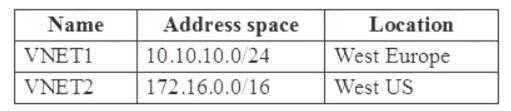
The virtual networks contain the following subnets: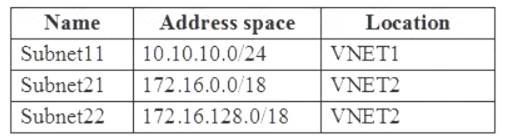
Subscription2 contains the following virtual network: Name: VNETA Address space: 10.10.128.0/17 Location: Canada Central
VNETA contains the following subnets: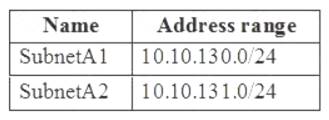
For each of the following statements, select Yes if the statement is true. Otherwise, select No.
NOTE: Each correct selection is worth one point.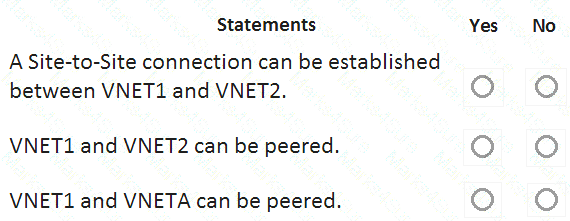
- A. Mastered
- B. Not Mastered
Answer: A
Explanation:
Box 1: Yes
With VNet-to-VNet you can connect Virtual Networks in Azure across Different regions. Box 2: Yes
Azure supports the following types of peering:
Virtual network peering: Connect virtual networks within the same Azure region. Global virtual network peering: Connecting virtual networks across Azure regions. Box 3: No
The virtual networks you peer must have non-overlapping IP address spaces. References:
https://azure.microsoft.com/en-us/blog/vnet-to-vnet-connecting-virtual-networks-in-azure-across-different-regio https://docs.microsoft.com/en-us/azure/virtual-network/virtual-network-manage-peering#requirements-and-cons
NEW QUESTION 11
Note: This question is part of a series of questions that present the same scenario. Each question in the series contains a unique solution that might meet the stated goals. Some question sets might have more than one correct solution, while others might not have a correct solution.
After you answer a question in this section, you will NOT be able to return to it. As a result, these questions will not appear in the review screen.
You have a computer named Computer1 that has a point-to-site VPN connection to an Azure virtual network named VNet1. The point-to-site connection uses a self-signed certificate.
From Azure, you download and install the VPN client configuration package on a computer named Computer2.
You need to ensure that you can establish a point-to-site VPN connection to VNet1 from Computer2. Solution: On Computer2, you set the Startup type for the IPSec Policy Agent service to Automatic.
Does this meet the goal?
- A. Yes
- B. No
Answer: B
Explanation:
Instead export the client certificate from Computer1 and install the certificate on Computer2.
Note: Each client computer that connects to a VNet using Point-to-Site must have a client certificate installed. You generate a client certificate from the self-signed root certificate, and then export and install the client certificate. If the client certificate is not installed, authentication fails.
References:
https://docs.microsoft.com/en-us/azure/vpn-gateway/vpn-gateway-certificates-point-to-site
NEW QUESTION 12
You have an Azure Active Directory tenant named Contoso.com that includes following users: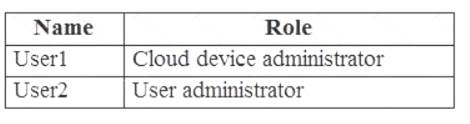
Contoso.com includes following Windows 10 devices: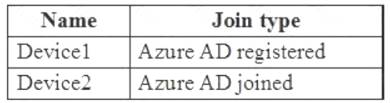
You create following security groups in Contoso.com: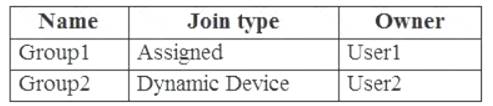
For each of the following statements, select Yes if the statement is true. Otherwise, select No.
NOTE: Each correct selection is worth one point.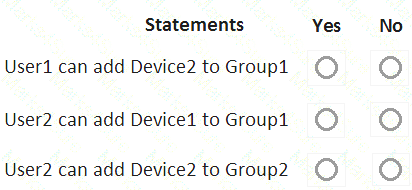
- A. Mastered
- B. Not Mastered
Answer: A
Explanation:
Box 1: Yes
User1 is a Cloud Device Administrator. Device2 is Azure AD joined.
Group1 has the assigned to join type. User1 is the owner of Group1.
Note: Assigned groups - Manually add users or devices into a static group.
Azure AD joined or hybrid Azure AD joined devices utilize an organizational account in Azure AD Box 2: No
User2 is a User Administrator. Device1 is Azure AD registered.
Group1 has the assigned join type, and the owner is User1.
Note: Azure AD registered devices utilize an account managed by the end user, this account is either a Microsoft account or another locally managed credential.
Box 3: Yes
User2 is a User Administrator. Device2 is Azure AD joined.
Group2 has the Dynamic Device join type, and the owner is User2. References:
https://docs.microsoft.com/en-us/azure/active-directory/devices/overview
NEW QUESTION 13
You have an Azure subscription that contains an Azure Availability Set named WEBPROD-AS-USE2 as shown in the following exhibit.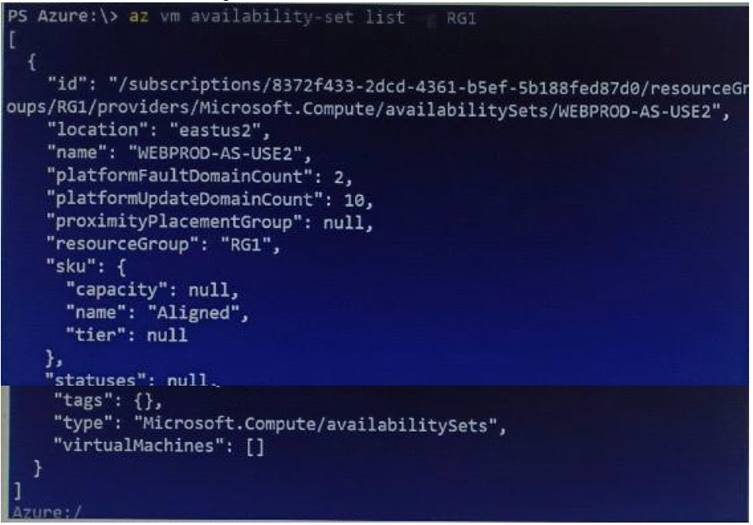
You add 14 virtual machines to WEBPROD-AS-USE2.
Use the drop-down menus to select the answer choice that completes each statement based on the information presented in the graphic.
NOTE: Each correct selection is worth one point.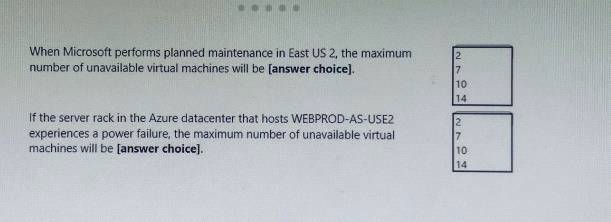
- A. Mastered
- B. Not Mastered
Answer: A
Explanation: 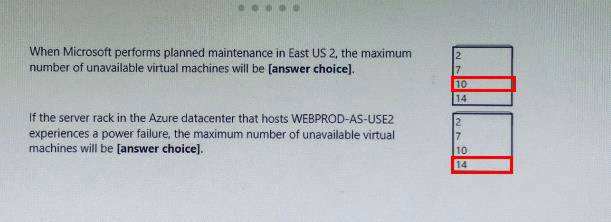
NEW QUESTION 14
Note: This question is part of a series of questions that present the same scenario. Each question in the series contains a unique solution that might meet the stated goals. Some question sets might have more than one correct solution, while others might not have a correct solution.
After you answer a question in this section, you will NOT be able to return to it. As a result, these questions will not appear in the review screen.
You have an Azure subscription named Subscription1 that contains the resources shown in the following table.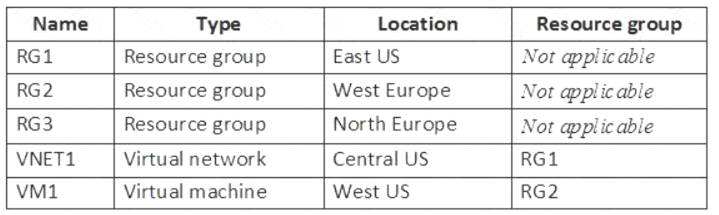
VM1 connects to a virtual network named VNET2 by using a network interface named NIC1. You need to create a new network interface named NIC2 for VM1.
Solution: You create NIC2 in RG2 and Central US. Does this meet the goal?
- A. Yes
- B. No
Answer: B
Explanation:
The virtual machine you attach a network interface to and the virtual network you connect it to must exist in the same location, here West US, also referred to as a region.
References:
https://docs.microsoft.com/en-us/azure/virtual-network/virtual-network-network-interface
NEW QUESTION 15
You need to implement Role1.
Which command should you run before you create Role1? To answer, select the appropriate options in the answer area.
NOTE: Each correct selection is worth one point.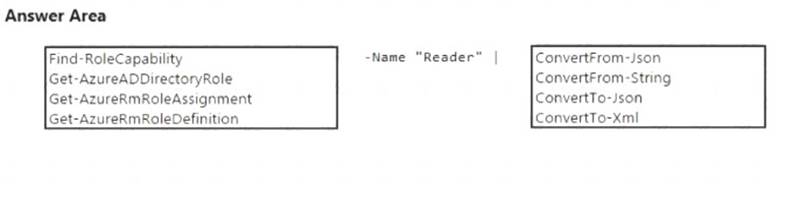
- A. Mastered
- B. Not Mastered
Answer: A
Explanation: 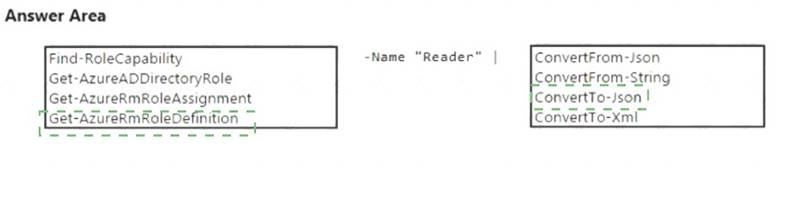
NEW QUESTION 16
Note: This question is part of a series of questions that present the same scenario. Each question in the series contains a unique solution that might meet the stated goals. Some question sets might have more than one correct solution, while others might not have a correct solution.
After you answer a question in this section, you will NOT be able to return to it. As a result, these questions will not appear in the review screen.
You have an Azure subscription that contains the following resources: A virtual network that has a subnet named Subnet1 Two network security groups (NSGs) named NSG-VM1 and NSG-Subnet1 A virtual machine named VM1 that has the required Windows Server configurations to allow Remote Desktop connections
NSG-Subnet1 has the default inbound security rules only.
NSG-VM1 has the default inbound security rules and the following custom inbound security rule: Priority: 100 Source: Any Source port range: * Destination: * Destination port range: 3389 Protocol: UDP Action: Allow
VM1 connects to Subnet1. NSG1-VM1 is associated to the network interface of VM1. NSG-Subnet1 is associated to Subnet1.
You need to be able to establish Remote Desktop connections from the internet to VM1.
Solution: You add an inbound security rule to NSG-Subnet1 that allows connections from the Internet source to the VirtualNetwork destination for port range 3389 and uses the UDP protocol.
Does this meet the goal?
- A. Yes
- B. No
Answer: B
NEW QUESTION 17
You need to resolve the Active Directory issue. What should you do?
- A. From Active Directory Users and Computers, select the user accounts, and then modify the User Principal Name value.
- B. Run idfix.exe, and then use the Edit action.
- C. From Active Directory Domains and Trusts, modify the list of UPN suffixes.
- D. From Azure AD Connect, modify the outbound synchronization rule.
Answer: B
Explanation:
IdFix is used to perform discovery and remediation of identity objects and their attributes in an on-premises Active Directory environment in preparation for migration to Azure Active Directory. IdFix is intended for the Active Directory administrators responsible for directory synchronization with Azure Active Directory.
Scenario: Active Directory Issue
Several users in humongousinsurance.com have UPNs that contain special characters. You suspect that some of the characters are unsupported in Azure AD.
References: https://www.microsoft.com/en-us/download/details.aspx?id=36832
NEW QUESTION 18
You have an Azure Active Directory (Azure AD) tenant named adatum.com that contains the users shown in the following table.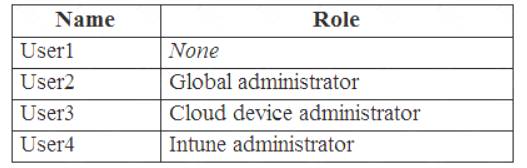
Adatum.com has the following configurations: Users may join devices to Azure AD is set to User1.
Additional local administrators on Azure AD joined devices is set to None.
You deploy Windows 10 to a computer named Computer. User1 joins Computer1 to adatum.com. You need to identify which users are added to the local Administrators group on Computer1.
- A. User1 only
- B. User1, User2, and User3 only
- C. User1 and User2 only
- D. User1, User2, User3, and User4
- E. User2 only
Answer: C
Explanation:
Users may join devices to Azure AD - This setting enables you to select the users who can register their devices as Azure AD joined devices. The default is All.
Additional local administrators on Azure AD joined devices - You can select the users that are granted local administrator rights on a device. Users added here are added to the Device Administrators role in Azure AD. Global administrators, here User2, in Azure AD and device owners are granted local administrator rights by default.
References:
https://docs.microsoft.com/en-us/azure/active-directory/devices/device-management-azure-portal
NEW QUESTION 19
You have an Azure subscription named Subcription1 that contains a resource group named RG1. In RG1. you create an internal load balancer named LB1 and a public load balancer named 162.
You need to ensure that an administrator named Admin 1 can manage LB1 and LB2. The solution must follow the principle of least privilege.
Which role should you assign to Admin1 for each task? To answer, select the appropriate options in the answer area.
NOTE: Caen correct selection is worth one point.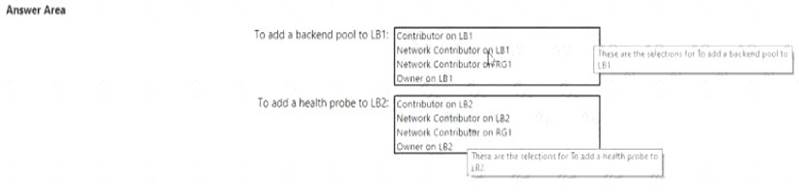
- A. Mastered
- B. Not Mastered
Answer: A
Explanation: 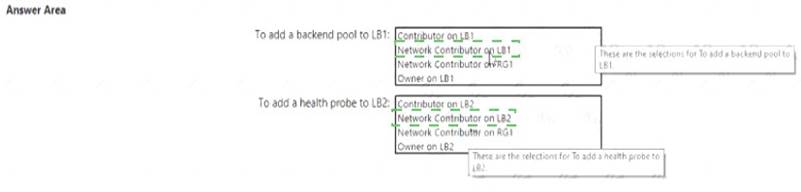
NEW QUESTION 20
Note: This question is part of a series of questions that present the same scenario. Each question in the series contains a unique solution that might meet the stated goals. Some question sets might have more than one correct solution, while others might not have a correct solution.
After you answer a question in this section, you will NOT be able to return to it. As a result, these questions will not appear in the review screen.
You have an Azure subscription that contains the following resources: A virtual network that has a subnet named Subnet1 Two network security groups (NSGs) named NSG-VM1 and NSG-Subnet1 A virtual machine named VM1 that has the required Windows Server configurations to allow Remote Desktop connections
NSG-Subnet1 has the default inbound security rules only.
NSG-VM1 has the default inbound security rules and the following custom inbound security rule:  Priority: 100 Source: Any Source port range: * Destination: * Destination port range: 3389 Protocol: UDP Action: Allow
VM1 connects to Subnet1. NSG1-VM1 is associated to the network interface of VM1. NSG-Subnet1 is associated to Subnet1.
You need to be able to establish Remote Desktop connections from the internet to VM1.
Solution: You modify the custom rule for NSG-VM1 to use the internet as a source and TCP as a protocol. Does this meet the goal?
- A. Yes
- B. No
Answer: A
Explanation:
The default port for RDP is TCP port 3389. A rule to permit RDP traffic must be created automatically when you create your VM.
Note on NSG-Subnet1: Azure routes network traffic between all subnets in a virtual network, by default. References:
https://docs.microsoft.com/en-us/azure/virtual-machines/troubleshooting/troubleshoot-rdp-connection
NEW QUESTION 21
You create a virtual machine scale set named Scale1. Scale1 is configured as shown in the following exhibit.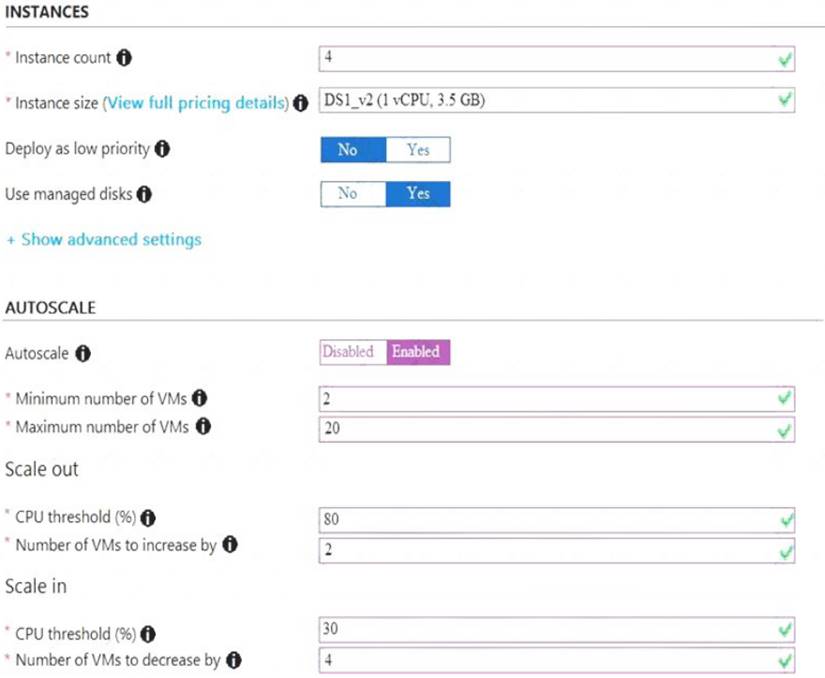
Use the drop-down menus to select the answer choice that completes each statement based on the information presented in the graphic.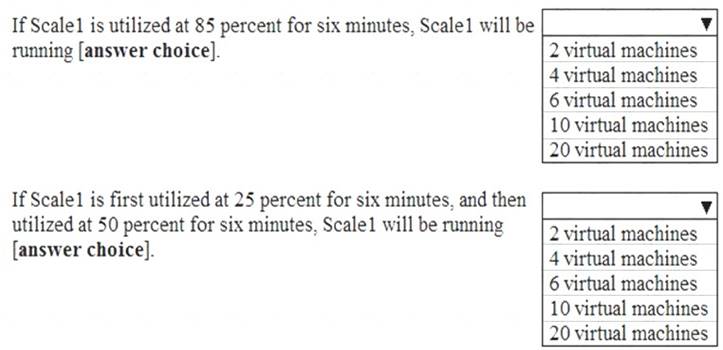
- A. Mastered
- B. Not Mastered
Answer: A
Explanation:
Box 1:
The Autoscale scale out rule increases the number of VMs by 2 if the CPU threshold is 80% or higher. The initial instance count is 4 and rises to 6 when the 2 extra instances of VMs are added.
Box 2:
The Autoscale scale in rule decreases the number of VMs by 4 if the CPU threshold is 30% or lower. The initial instance count is 4 and thus cannot be reduced to 0 as the minimum instances is set to 2. Instances are only added when the CPU threshold reaches 80%.
References:
https://docs.microsoft.com/en-us/azure/azure-monitor/platform/autoscale-overview https://docs.microsoft.com/en-us/azure/azure-monitor/platform/autoscale-best-practices https://docs.microsoft.com/en-us/azure/azure-monitor/platform/autoscale-common-scale-patterns
NEW QUESTION 22
You have an Azure subscription that contains an Azure Directory (Azure AD) tenant named contoso.com. The tenant is synced to the on-premises Active Directory domain. The domain contains the users shown in the following table.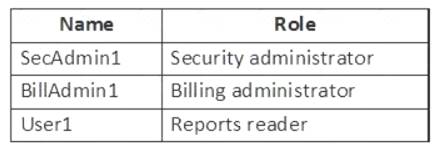
You enable self-service password reset (SSPR) for all users and configure SSPR to have the following authentication methods: Number of methods required to reset: 2 Methods available to users: Mobile phone, Security questions Number of questions required to register: 3 Number of questions required to reset: 3 You select the following security questions: What is your favorite food? In what city was your first job? What was the name of your first pet?
For each of the following statements, select Yes if the statement is true. Otherwise, select No. NOTE: Each correct selection is worth one point.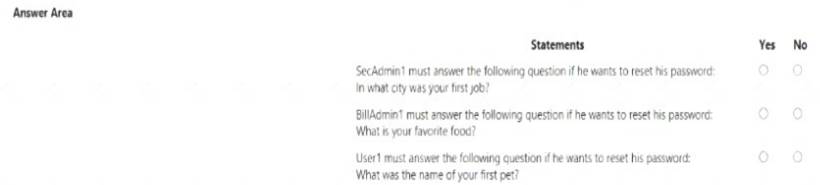
- A. Mastered
- B. Not Mastered
Answer: A
Explanation:
Box 1: No
Administrator accounts are special accounts with elevated permissions. To secure them, the following restrictions apply to changing passwords of administrators:
On-premises enterprise administrators or domain administrators cannot reset their password through
Self-service password reset (SSPR). They can only change their password in their on-premises environment. Thus, we recommend not syncing on-prem AD admin accounts to Azure AD.
An administrator cannot use secret Questions & Answers as a method to reset password. Box 2: Yes
Self-service password reset (SSPR) is an Azure Active Directory feature that enables employees to reset their passwords without needing to contact IT staff.
Box 3: Yes References:
https://docs.microsoft.com/en-us/azure/active-directory/authentication/howto-sspr-deployment
NEW QUESTION 23
......
Thanks for reading the newest AZ-104 exam dumps! We recommend you to try the PREMIUM Certleader AZ-104 dumps in VCE and PDF here: https://www.certleader.com/AZ-104-dumps.html (0 Q&As Dumps)